More drilling does not equal more jobs: Why the link between production and employment has broken

Concern over declining oil and gas jobs has been central to the debate over new drilling. Oil and gas workers have borne the brunt of a declining basin, an industry that has consistently prioritised shareholder profits over investment in the transition, and a total lack of transition planning from the Scottish Government and – until recently – the UK Government. There is still far to go for both, but the data is clear: the answer to a decline in oil and gas employment is not new drilling.
The link between production and employment is broken
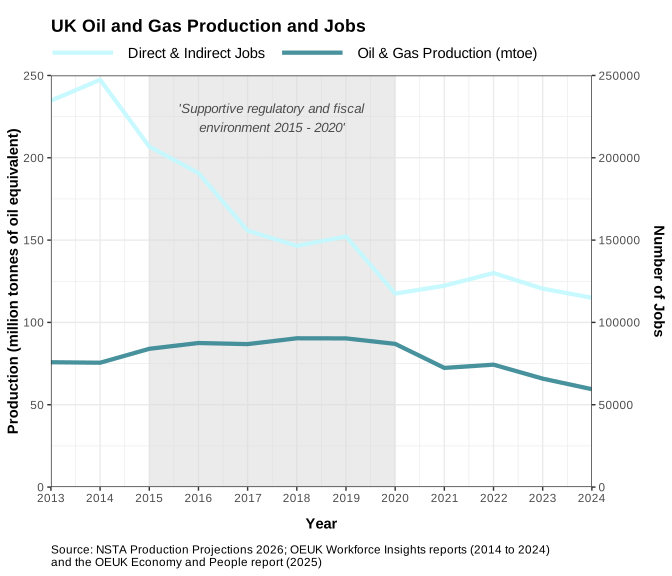
Even during the period defined by industry as a “supportive regulatory and fiscal environment”, employment within the oil and gas sector fell sharply. Between 2013 and 20191, which included the introduction of the Conservative Government’s policy of “maximum economic recovery” (MER), UK net oil and gas production increased by 19% (with net gas production rising only 7% and net oil production by 29%)2. Despite these increases, the direct oil and gas workforce fell by 17%, and the combined direct and indirect workforce fell by 35%3.
"UK production increased by nearly 20% between 2013 and 2019 - but the wider O&G workforce fell by 35%"
These findings are supported by other independent analysis that showed although “for most of the basin's history, production and employment moved in lockstep...this link has now broken”.
This analysis also found that employment in Aberdeen’s oil and gas sector fell by 11% between 2014 and 2019, while production rose by a fifth. Output and jobs moved in the opposite direction during the one period when more oil was actually being produced.
When we take a broader look at the last decade we see that direct and indirect oil and gas jobs have halved, reducing from 247,400 jobs in 2014 to 115,000 in 2024.3 Oil and gas jobs are predicted to decline regardless of predicted levels of production.
The basin is still in decline
Under the industry-termed “supportive regulatory and fiscal environment”, production remained roughly flat (or rose modestly, depending on your starting-date assumption). But the basin is still in overall decline.
The North Sea is an ultra-mature basin where production has been falling for decades, with most of the oil and gas it once contained now already extracted. Since 1998, production has decreased annually by approximately 5% on average, and the North Sea Transition Authority forecasts an average annual decline of about 10% until 20504.
Despite the previous Government's efforts, modest production increases did not meaningfully meet UK demand. From 2010 to 2024, the Conservative Government handed out hundreds of new North Sea oil and gas licences across seven licensing rounds which so far have led to just 36 days of extra gas.
It is clear that efforts to squeeze additional drops from a dwindling basin did not stop thousands of job cuts or substantially increase domestic gas production to sufficiently meet demand. Workers need a plan for what comes next and it can’t be solely left up to industry. It is crucial that the Government supports oil and gas workers’ transition.

What is needed from Government
We cannot afford to leave the transition up to oil and gas companies, the vast majority of which have not planned to shift investment away from fossil fuels. Their plan is to extract as much profit out of the declining basin as they can before quitting.
If this Burnham Government is serious about rewiring the country and delivering growth to left-behind communities, it should start by rejecting new oil and gas projects like Rosebank and Jackdaw that will do next to nothing to stem the decline in North Sea jobs, and instead focus all of its efforts on investing in renewables and other industries that have a future – like offshore wind manufacturing. To approve new oil and gas now would be to kick the can down the road while sending contradictory messages to investors and drawing focus away from what is actually needed to create jobs.
The focus should then be on enabling the UK’s energy workforce to transfer into these jobs – focusing on the communities and regions most affected by oil and gas decline.
The UK’s oil capital, Aberdeen, has had a “disastrous decade”, and is now forecast to have the slowest growth of any UK city. But, with focused investment, and more municipal ownership of renewables projects, jobs and wealth can be brought back to this community and others like it.
Methodology
- Changes in oil and gas production and the workforce between 2013 and 2019 were calculated as the percentage change between the 2013 and 2019 figures. We chose 2013 as the start year to capture pre-policy change as a baseline. The end year, 2019, was chosen to avoid COVID's effect on employment in 2020.
- Oil and gas historical production and projections were taken from the February 2026 NSTA production projections data.
- Oil and gas direct and indirect workforce estimates were taken from the annual OEUK Workforce Insights reports (2017 to 2024) and the OEUK Economy and People report (2025).
- Average annual trends in oil and gas production were calculated by averaging the year-on-year percentage change in production over the chosen time period.
References
Related news