Why Norway isn't a blueprint for the UK’s oil and gas regime
the geological and fiscal realities that divide us
It’s a fact that the most productive and economically lucrative days of North Sea oil and gas in the UK are behind us, with production now in steep decline. The UK has drained 93% of the oil and gas that is likely to be produced from the North Sea. What’s left is mainly oil, around 80% of which we export.
Critics of ending new oil and gas licensing often point to Norway and the national wealth fund it has built through its oil and gas industry, as evidence that it can be done. That the UK can continue to have a thriving oil and gas industry and that it’s mere political will that’s holding us back. But the real picture is very different.
Our geology is not the same
The fact is, the UK Continental shelf is smaller than Norway's. The median-line settlement gave Norway a shelf that extends into the Norwegian Sea and Barents Sea, while the UKCS is essentially the gas fields of the Southern North Sea, the Central and Northern North Sea, plus the West of Shetland margin. The UK has never developed other parts of the North Atlantic.
Norway's oil and gas has historically been concentrated in fewer, larger structures (Ekofisk, Statfjord, Troll, more recently Johan Sverdrup), whereas the UK's resources have been more fragmented sitting in smaller fields, with a few exceptions (e.g. Brent). This not only raises the production costs, it also shortens the field's lifetime.
Norway managed its depletion
Second, the Norwegian Continental Shelf, while still in steady decline overall, is less exhausted than the UK Continental Shelf. After 50 years of drilling, the UK has now produced roughly 90% of everything it is likely to recover; Norway is at 70%.1
This is, in part, due to the deliberate choice to privatise North Sea assets in the 1980s which led to rapid extraction of resources by profit-driven private companies rather than the steady, managed extraction overseen by Norway, which is why it is still making new discoveries.
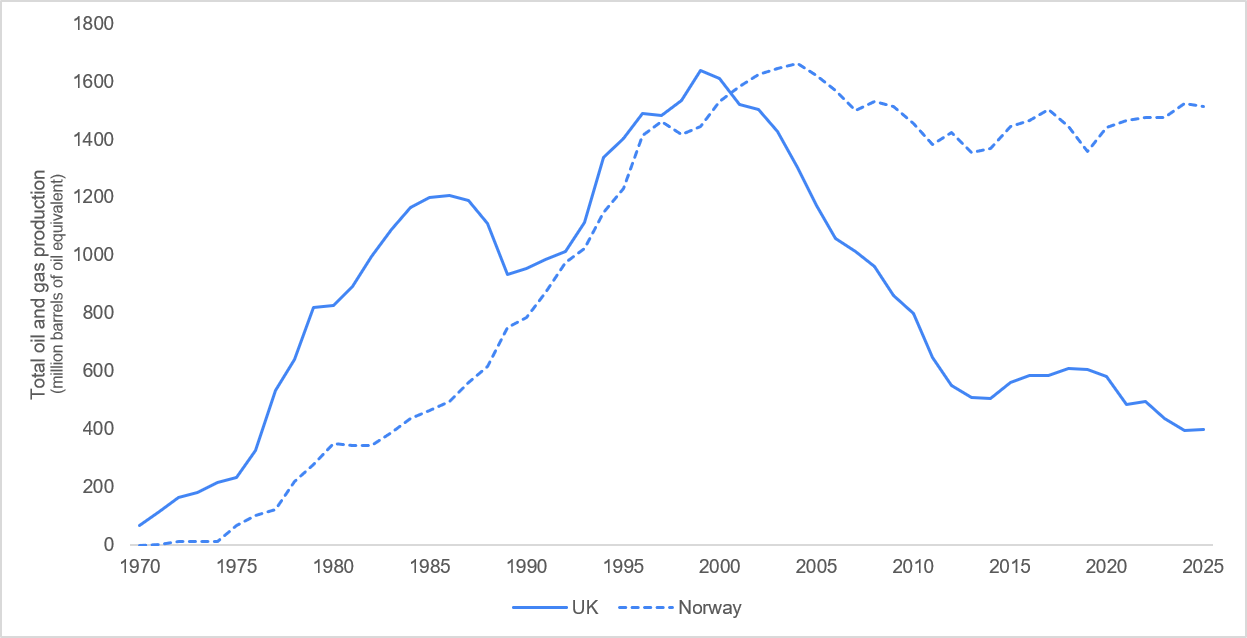
Sources: UK oil and gas production from 1998 to 2025 is based on NSTA Feb 2026 production projections (NSTA, 2026)As NSTA Feb 2026 production projections only go back to 1998, UK oil and gas production from 1970 to 1997 is based on historic NSTA production projections (NSTA, 2025)Norway oil and gas production is based on NorskPetroleum’s Annual Estimates (Norwegian Offshore Directorate, 2026)
As the graph above shows, the UK led Norway on output for thirty years. As late as 1985 we were producing two and a half times more. Norway only overtook in 2001.
Norway owns its oil and gas assets
The economic outcomes Norway has achieved from its oil and gas industry are not the result of simply drilling more - they are the product of structural features, such as state ownership and a stable tax regime, that have been embedded throughout the development of the basin. It is not possible for the UK, having already extracted the vast majority of recoverable resources after six decades of drilling, to now replicate these.
Norway has built much of its wealth through state ownership of its oil and gas assets including its largest energy company, Equinor. Norway owns 67% of Equinor's shares and holds direct financial interests in most major fields through the State's Direct Financial Interest (SDFI) system, meaning the state owns roughly a third of Norway's proven oil and gas reserves outright.
Therefore, a large share of the return flows to the state as an owner, not just as a tax collector. This is a structural choice the UK abandoned when it privatised its North Sea holdings, such as Britoil, Enterprise Oil, and BGC's assets.
Norway taxes oil and gas properly
On the subject of tax, Norway also stands to benefit much more from its oil and gas activity than the UK thanks to its combined 78% marginal tax rate on petroleum profits, which it has held at that level for decades.
The UK, by comparison, has presided over one of the most generous tax regimes for oil and gas in which some years companies like Shell have ended up paying negative tax. Although the Energy Profits Levy was raised to 38% in November 2024, bringing the headline rate in line with Norway, it is due to be replaced in 2030 with a lower and narrower Oil and Gas Revenue Levy, a 35% levy that only applies when prices exceed set thresholds.
The volatility in the UK’s system is precisely what erodes the long-run investment certainty and predictable revenue that a stable regime like Norway's provides. As much as we might like to, there is no way the UK can retroactively reap the benefits of this.
There are also big differences in how tax revenue is spent between the two countries. Norway invests it in its sovereign wealth fund (the Government Pension Fund Global) which, by early 2026, surpassed $2.1 trillion in market value, solidifying its status as the world’s largest sovereign wealth fund.
The UK has no equivalent. North Sea tax revenue is absorbed into general Government spending, and while precise counterfactuals about exactly how much this cost the UK are contested, analysis conducted in 2023 found that production during low-price periods, lower long-run tax take, and a lack of equity stakes may have cost the UK in the region of $400 billion in foregone revenue compared with a Norway-style approach.
How does this play out for Rosebank?
Rosebank, the largest undeveloped field, illustrates how this plays out on a single project. The field is currently owned by Adura, a joint venture between Shell and Norwegian state-backed Equinor, holding an 80% stake, and Ithaca Energy, which holds the remaining 20%.
Analysis by WWF Norway modelled a base case of $70-a-barrel oil in which the Treasury would make a net a loss of around £258m on Rosebank, while Adura and Ithaca would earn roughly £1.5bn in profit; in a lower $40-a-barrel scenario, the Treasury shortfall was modelled at up to £1.3bn. If the field goes ahead, a meaningful share of its value stands to flow to the Norwegian state's own wealth fund.
All is not lost
We cannot undo the decisions which have led to our current situation but we can learn from our mistakes and Norway’s successes and apply them to the next phase of our industrial future. Today, the UK has a huge opportunity to establish a world-leading offshore wind and wind manufacturing sector and to ensure that the benefits of this are felt first and foremost by the British public and particularly by communities previously reliant on oil and gas.
The Government has already taken many welcome steps to ensure that the benefits of the energy transition are captured by the public, for example by establishing the publicly-owned energy investment firm, GB Energy, and setting up the National Wealth Fund. It has also taken steps to ensure that support is targeted for example with the Clean Industry Bonus, which rewards offshore wind developers that target their investment in deprived areas of the UK or in cleaner supply chains.
However, there is much more that needs to be done. For example, through greater national and municipal ownership of wind projects, the UK and Scottish governments could use their share of the profits to fund public services and support local communities, rather than seeing profits flow to private shareholders. Greater community ownership programmes would also give local communities a meaningful stake in the energy we manufacture and generate across the UK.
Next, to ensure a fair transition for workers, the Government needs to mandate that renewable energy companies recruit from within the existing oil and gas supply chain which currently employs approximately 90% of the broader workforce. Supporting the existing supply chain, and those working within it, to form part of the renewables supply chain is essential.
Final word
We are fortunate in the UK that the climate imperative to ditch fossil fuels aligns with our economic and growth goals. Our over-reliance on fossil fuels is costing us. New drilling won’t help since the vast majority of what's left in the North Sea is oil, not gas, and most of that (around 80%) gets exported. The only way to get off expensive fossil fuels and achieve genuine economic growth is through a rapid transition to homegrown renewable energy. We now need to ensure that the UK does not repeat the mistakes of the past and maximises the benefits from this energy transition.
References
Related news