Briefing: Jackdaw Gas Field
The UK government will soon make a decision on whether to approve or reject Jackdaw, a new North Sea gas field. Jackdaw is owned and operated by Adura, a joint venture between Shell and Equinor.
First approved in 2022, Jackdaw was ruled unlawful last year by the Scottish courts, along with the huge Rosebank oil field, for failing to take into account its full impact on the climate. This time around, any decision will require a complete assessment of the emissions that would be released from extracting and, for the first time, burning these reserves. The decision rests with the Secretary of State for Energy Security and Net Zero.
In brief
- Jackdaw, a relatively small gas field, would have no meaningful impact on the UK’s energy security, providing just 2% of UK gas demand over its roughly 10 year lifetime.
- It will also have no impact on our energy bills, which have risen as a result of the increase in wholesale gas prices, driven by the ongoing conflict in the Middle East.
- No new oil and gas fields are compatible with safe climate limits: existing global oil and gas reserves already far exceed what can be safely burned. New drilling, particularly on the scale of the huge Rosebank oil field, is the defining test of this Labour government’s commitment to tackling climate change.
Jackdaw will make no meaningful difference to UK energy security
Jackdaw is a relatively small field that will do next to nothing to reduce the UK’s dependence on gas imports. Even in the most optimistic scenario and assuming none of its gas is exported, its reserves would provide just 2% of UK annual gas demand on average over its roughly 10-year lifetime. Put another way, Jackdaw’s gas would, on its own, power the UK for just over two months at current levels of demand.
After 50 years of drilling, the UK has now burned most of its gas. Official projections show that the UK’s reliance on imports is set to rise from around 55% today to more than two-thirds dependent by 2030, and over 90% dependent on gas imports by 2050 – even if new fields like Jackdaw are developed. Most of what is left in the ageing North Sea is oil, the vast majority of which is exported.
Jackdaw will not lower energy bills
With prices set on international markets, Jackdaw would make no difference to UK energy bills – a fact that advocates of more drilling have publicly admitted.
UK energy bills are being driven higher by rising wholesale gas prices, as a result of the ongoing conflict in the Middle East. The last energy crisis, following Russia’s invasion of Ukraine that sent gas prices soaring, cost the UK more than £180 billion over four years and pushed millions of households into fuel poverty.
To lower energy costs long term, the UK needs to reduce its reliance on gas through switching to renewable energy. The UK’s offshore wind farms and solar installations are already replacing gas in the system and helping to hold down electricity prices; in one month alone this year, wind and solar saved the UK from gas imports worth £1bn.
UK gas production is not better for the environment than imports
The claim that domestic gas production is “better for the climate” than imports is extremely misleading. It compares UK oil and gas to the very dirtiest gas imports (LNG) which make up a minority of the UK’s overall imports.
These comparisons also tell us only how polluting the gas was to produce. Once it’s burned, the differences are negligible: when taking into account the emissions from combusting the gas, North Sea gas emissions are only about 15% lower than LNG.
The overwhelming majority of the UK’s gas imports (69% in 2025) come via pipeline from Norway, where gas production is almost four times less polluting, or emissions-intensive, than UK gas production. Norway halted practices like emergency flaring of gas decades ago, whereas it currently still takes place in the UK.
Jackdaw won’t stem the decline of North Sea Jobs
Jackdaw will not stop the decline in the North Sea workforce, which has seen jobs supported by the industry more than halve in the past decade, despite new field approvals.
The link between output and jobs has broken: North Sea production rose by a fifth between 2014 and 2019, while employment in Aberdeen’s oil and gas sector fell by 11 per cent, suggesting that more production no longer means more jobs.
With the North Sea’s oil and gas reserves in terminal decline, the only way to protect UK energy workers is to invest in renewable and other industries with a long-term future and to create clear pathways into new, good-quality jobs in those industries.
New oil and gas fields are incompatible with safe climate limits
The science shows that existing and approved global oil and gas reserves already far exceed what can be safely burned in a world committed to limiting warming to 1.5°C. In short, we cannot afford to burn the reserves we already have, let alone develop new ones.
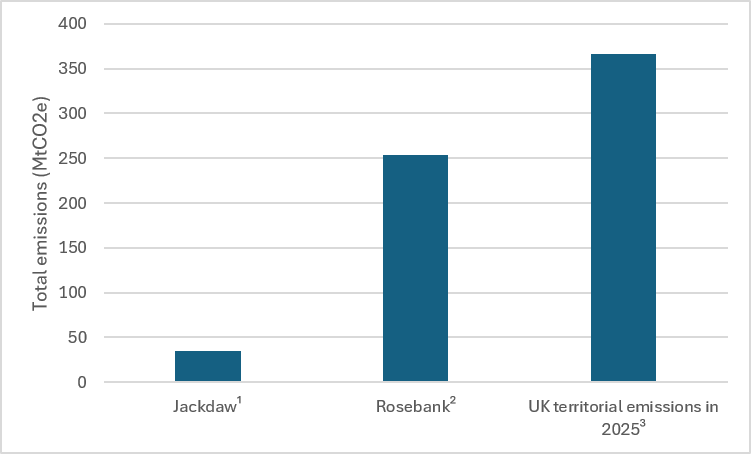
The government is currently considering two new fields: Jackdaw, which could emit over 35 million tonnes of CO2e, if developed; and the huge Rosebank oil field, the UK’s largest undeveloped field. Burning Rosebank’s reserves would release over 250m million tonnes of CO₂e. That’s the equivalent of nearly 70% of the UK's entire annual emissions in 2025.
1. Jackdaw Field Development: Response to Regulation 12(1) Notice (Adura, 2026)
2. Rosebank Field Development: Response to Regulation 12(1) Notice (Adura, 2026)
3. 2025 UK GHG emissions: provisional figures - statistical release (Department for Energy Security and Net Zero, 2026)
A field on the scale of Rosebank is fundamentally incompatible with any credible pathway to 1.5°C and the UK’s commitments under the Paris Agreement. It is the defining test of this Labour government’s credibility on climate change. We are already seeing the devastating impacts of rising global temperatures. The severe heatwaves, droughts, and wildfires impacting the UK, as well as increasingly extreme weather around the world, demonstrate how rapidly climate risk escalates with every fraction of a degree. It would be irresponsible in the extreme for this Labour government to knowingly add fuel to these impacts by allowing new drilling.
Uplift media contact: Holly McElhone: holly.mc@upliftuk.org; 07360651711
References
Related news